

A featured contribution from Leadership Perspectives: a curated forum reserved for leaders nominated by our subscribers and vetted by the Construction Tech Review Advisory Board.

Auckland Council Community Facilities Department
Lessons From Evolving our EAM System Without Breaking the Bank

Raymond Tan
As with most public sector organizations in the world, Auckland Council (serving a population of 1.6 million) is expected to achieve value-for-money for its ratepayers through achieving effectiveness and efficiency as business-as-usual, not simply as a one-off objective. The quality of asset management (AM) decisions, such as whether to replace or to maintain an aging asset, can only be as good as the information used to support the decision-making. Our Enterprise Asset Management System (EAMS) is considered the engine room for all of council business transactions – it helps to extract value by changing the way our assets are managed. However, simply having more information does not necessarily result in more effective decisions. Research has indicated that up to 70 percent of recorded data is never used for asset management despite the significant investment put into capturing this information. One of the root causes is the lack of a properly implemented Enterprise Information Strategy (EIS). Without a good strategy, it is impossible to achieve a closer alignment between information and the resulting decisions for optimizing asset and organization performance.
Three years ago, our Community Facilities (CF) department embarked on a journey, departing from traditional data management towards an approach that treats information as a strategic asset that creates business value. With a responsibility to maintain $11bn of community assets (including open spaces, buildings, and infrastructure), we have made several discoveries in our evolution. The journey is by no means complete, but it became obvious that technology alone could not address all the issues or deliver any value without the synthesis of people, process, and technology working in unison.
Maintaining and providing good quality and useful information is only one part of a complex task of enterprise information management. Successful change requires an information strategy to be implemented both top-down and bottom-up.
Top management needs to take responsibility for information quality which may require further training on what the quality criteria should be and how the accuracy of business planning and decision-making can be improved or business risks minimized. Even acknowledging that there are issues is a critical first step for any organization contemplating the start of that journey.
In our case, bottom-up evolution first involved getting buy-in from staff. Other stakeholders then needed to be sold that disruption to operation (up to 12 months) as a result of changes to the asset meta- and master-data was the only option available so that we could move away from the status quo of cobbling together information from inconsistent asset hierarchies, incomplete asset attributes, and missing critical information.
Turning raw data into useful information as inputs to create asset intelligence requires specific efforts to ensure that people understand how information can enhance decision-making
A key lesson was acknowledging that the importance of different data typescan greatly shift over time –information considered not-critical to the organization five years ago is now crucial, so we needed to identify the lost value in our data gaps, and rectify accordingly.
Even when the above has been accomplished, it is important to realize that any EAMS and its information do not have any intrinsic value until it can be used. Hence a key part of our successful implementation was reaching out to current and potential users of the new information and EAMS capability. While staff readily agrees that information is very important, very few could articulate how such information is being put to effective use. Turning raw data into useful information as inputs to create asset intelligence requires specific efforts to ensure that people understand how information can enhance decision-making. Appreciating this is as much a cultural shift as it is technological. For many organizations, information is considered important only when one realizes that something is missing, particularly when solving a problem or dealing with a crisis. For effective asset information management, it is pivotal that the right culture is present with which the EAMS operates.
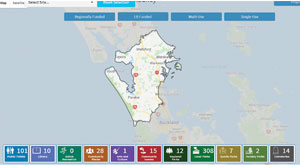
Presenting a holistic and complete picture of the business in a clear and concise manner needs to be aligned to stakeholders’ expectation. CF developed the Central Reporting Asset Management (CRAM) tool in-house which won the 2018 SOLGM Asset Management Innovation Award.
The tool was able to breakdown silos and strengthen relationships across the organization by making critical information for decision-making readily available. There was a significant shift in attitude towards evidence-based decision making and operational efficiencies through a knowledge-based approach adopting best practices and learning from past mistakes.
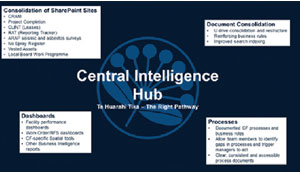
Exhibit II below illustrates the building blocks of a Central Intelligence Hub currently being developed utilizing existing information from the EAMS and other information sources. The Hub identifies four separate information domains that will enable more detailed data collection, analysis, and information utilization.
From our experience, lack of awareness, lack of trust, and fear of change are common behaviors inhibiting the successful implementing of an EIS or EAMS. Instilling the right culture would involve nurturing analysts, AM specialists, management, and frontline staff so that they can thrive in information-rich, knowledge-based environment.
Collaboration and engagement are required to integrate technology capability and business needs fully. Operational policies and processes could align with information collection and maintenance methodology. Relevance and currency of information throughout the asset lifecycle require well-documented standards, quality criteria, ownership, and stewardship.
